Sunday, September 29, 2019

"Are You Orthodox?" (Part 8)

I'd been at Iviron long enough.  With the Great Lavra out of reach, it was time to find Father Andreas.

He no longer lived where Dad and I met him four years earlier.  He had returned to his old monastery, Aghiou Pavlou (St. Paul's), farther down the western coast of the peninsula.  Getting there would require taking the early morning bus to Karyes and onward to Dafni on the coast.  There I would meet the daily southbound caïque coming from Ouranoupolis.  The caïque would deliver me to St. Paul's.

But first, a good-bye to the guest-master, Brother Kosmas.  Was his embrace oddly prolonged, his brotherly kiss unusually fervent?  Or was it just my imagination?


*  *  *

Dafni
I reached Dafni around 9:30 a.m.  There I learned I would not be waiting for the arrival -- at 1:00, no less -- of the roomy southbound caïque from Ouranoupolis.  Rather, I would be waiting for the departure at 1:00 of a junior caïque.  There it was, bobbing alongside the Dafni pier, teasing me with its unavailability till 1:00.

With only two cafés, two souvenir shops, and nothing of the remotest historical interest anywhere within walking distance, it promised to be a long 3½-hour wait.  I opted for one of the cafés, where I could at least read and write.

But reading and writing proved difficultAt other tables, clutches of monks, priests, and lay brothers smoked, drank coffee, and talked.  And talked, and talked, and talked in a non-stop bombast.

Were they elucidating the procession of the Holy Spirit?  Were they debating the true nature of the Holy Trinity?

Sadly, no.  The topics of these loud, animated exchanges were painfully mundane.  One particularly energetic row was over the relative merits of the paths between one monastery and another.  Details of each path were dissected and compared with anatomical precision.  One path was extolled over another for its time-saving blessings.  Another particularly heated exchange was about whether it was here or there on the path where Brother So-and-So had been overtaken last month.  One old priest went at it non-stop for over an hour -- standing the whole time!

Such were the fruits of a lifetime of prayer.


*  *  *

The large caïque from Ouranoupolis arrived packed.  Among its passengers were the young priest from the prior evening and his friends Manolis and Takis.  While I was making my way to Dafni by bus, they had walked from Iviron to Xeropotamou and from there to Roussikon, where they had caught the boat from Ouranoupolis.

I had been under the mis-impression that the large Ouranoupolis caïque serviced the entire western coast of the peninsula and would therefore continue southward from Dafni.  But Dafni proved to be its terminus.  Passengers who needed to proceed farther south transferred to the smaller caïque, which was no larger than Ammouliani of four years earlier.  But unlike Ammouliani it was burdened with forty-five squirming passengers, their baggage, and additional southbound cargo.


*  *  *

Before St. Paul's there were intervening stops at the monasteries of Simonopetra, Grigoriou, and Dionysiou.

Simonopetra
While cruising between stops, there was barely a sound from the passengers.  Silence prevailed except for the chugging of the diesel engine and the plashing of the boat's bow wave against the hull.

But everything changed as the boat approached a landing.  The first decrease in engine revs was the signal to start the ritual of commotion that punctuated each stop.

First came impatient stirrings by the passengers.  As the boat slowed even more, the stirrings became anxious (and pointless) strivings to get off.

Grigoriou
These movements elicited the captain's barks:  "Don't rush!  You'll all get off!"

In the final few yards before the boat touched the bulkhead, volleys of shouts erupted like cannonades between ship and shore"Where's so-and-so?"  "Grab there!"  "Did you load such-and-such?"  "Hold off!" 

Dionysiou
Then came the effusive greetings, hugs, kisses, backslaps, etc. as disembarking passengers and those still aboard greeted their friends ashore.  The felicitations continued in high gear all the while the boat was tied up.

They immediately subsided, however, when the boat pulled away for its next destination.  Silence, diesel chugging, and bow-wave plashing reigned supreme again until the ritual was repeated at the next stop.


*  *  *

 We reached St. Paul's in forty-five minutes.

The monastery is built against a crease in the foothills of Mt. Athos.  From the landing, its crenellated wall and tower gave it the appearance of a castle.

St. Paul's from the landing
The name "St. Paul's" has murky origins but is probably attributable to the monstery's late-10th-century founder, Paul Xeropotaminos, rather than to the author of the Epistles.  The monastery is dedicated to the Purification of the Virgin.

It was a Serbian kellion before acquiring the status of a monastery and taking its place in the Athonite hierarchy by the late 14th century.  Benefactors have included Byzantine emperors, Russian tsars, Serbian princes, and the rulers of the lower Danubian kingdoms.  Its holy relics include the Gifts of the Magi and a fragment of the True Cross.

The monastery's fortunes have risen and fallen over the centuries.  The 17th century saw two hundred monks in residence.  But during the Greek struggle for independence (1821-1830), St. Paul's was nearly deserted.  The monastery was re-established by Patriarch Gregorios VI in 1840.

The main structures looked older than they actually were.  The relatively unadorned but solid-marble katholikon was finished in 1844.  It of course replaced a much older one, but its 19th century construction made it a relative newcomer on the Holy Mountain.  At the beginning of the 20th century, a disastrous fire (1902) and floods (1911) required much rebuilding.  St. Paul's is also said to be the first monastery on the peninsula to be associated with a road, a pre-1963 construction that facilitated the delivery of timber from the mountain above to the landing below.

At the time of my visit, St. Paul's was cenobitic and had about ninety monks.  Thirty-five lived in the monastery proper, the rest in various dependencies.


*  *  *
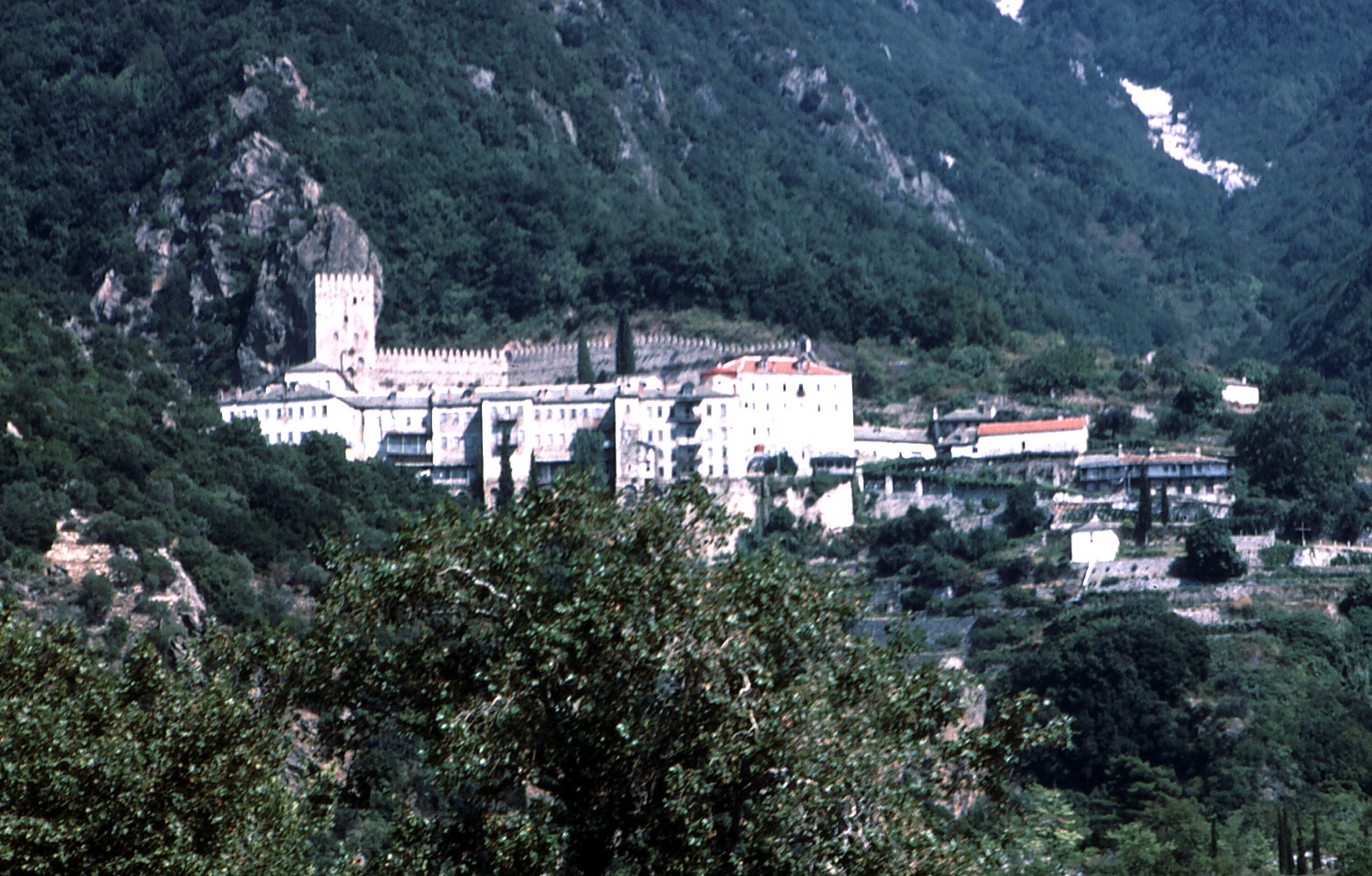

A half hour's walk from the landing brought me to the main gate.  On entering the monastery, we new arrivals were ushered immediately into the katholikon.  Someone thrust a candle into my hand, which a monk promptly lit.

A funeral was underway in the nave, which had been closed off from the crossing by a curtain stretching from pillar to pillar.  The deceased lay a few inches above the floor on a simple wooden pallet.  His feet pointed to the altar; an icon rested on his chest.

I feared the funeral was for Father Andreas.  He had been sick, I was told.  I couldn't be sure, however, because the deceased monk's face wasn't in view.  His body was wrapped in a black garment (perhaps his daily vestment) and was covered with a colorful cloth (perhaps an aer, a liturgical veil interpreted as the shroud of Christ).

Monks shuffled back and forth as they read through the service.  At the final prayers, each monk approached the body and, facing the altar, took a position to one side or the other of the deceased's head.  One by one, each monk crossed himself three times, each time touching the floor with both hands on the bottom stroke.  Each monk then removed his headgear and bent to kiss the icon on the deceased's chest and then the dead monk's forehead.  With headgear re-secured, the floor-touch crossings were repeated three times.

Burial followed immediately.  The body was carried out of the katholikon to the tolling of a single bell and the striking of a horseshoe-shaped gong (an iron semandron) in a peculiar three-beat rhythm.  Everyone followed.

The procession passed out of the main gate, down a short vine-covered path, and into the cemetery through a small gate.  Past the small ossuary (where three monks remained to say prayers), the group assembled in a corner of the cemetery where a narrow grave had already been dug.  More prayers.  Then the colored covering was removed from the body.  Two younger monks took hold of the feet and shoulders.  With a grunted "Opa!" they lifted the corpse off the pallet and swung it into the grave.

The body was not stiff.  I saw it bend at the waist.  I later learned that the flexibility of monks' corpses at burial is said to be a phenomenon unique to Mt. Athos.

After a few more prayers, a couple of monks quickly filled the grave with dirt using garden hoes and forceful strokes.  They seemed to want to be done with the matter quickly.  With the grave filled, all faced Mt. Athos (or something else in that direction) while one monk intoned one hundred times "Your servant is at rest," keeping count by fingering his koumboskene.  As this went on, all the other monks crossed themselves continuously.
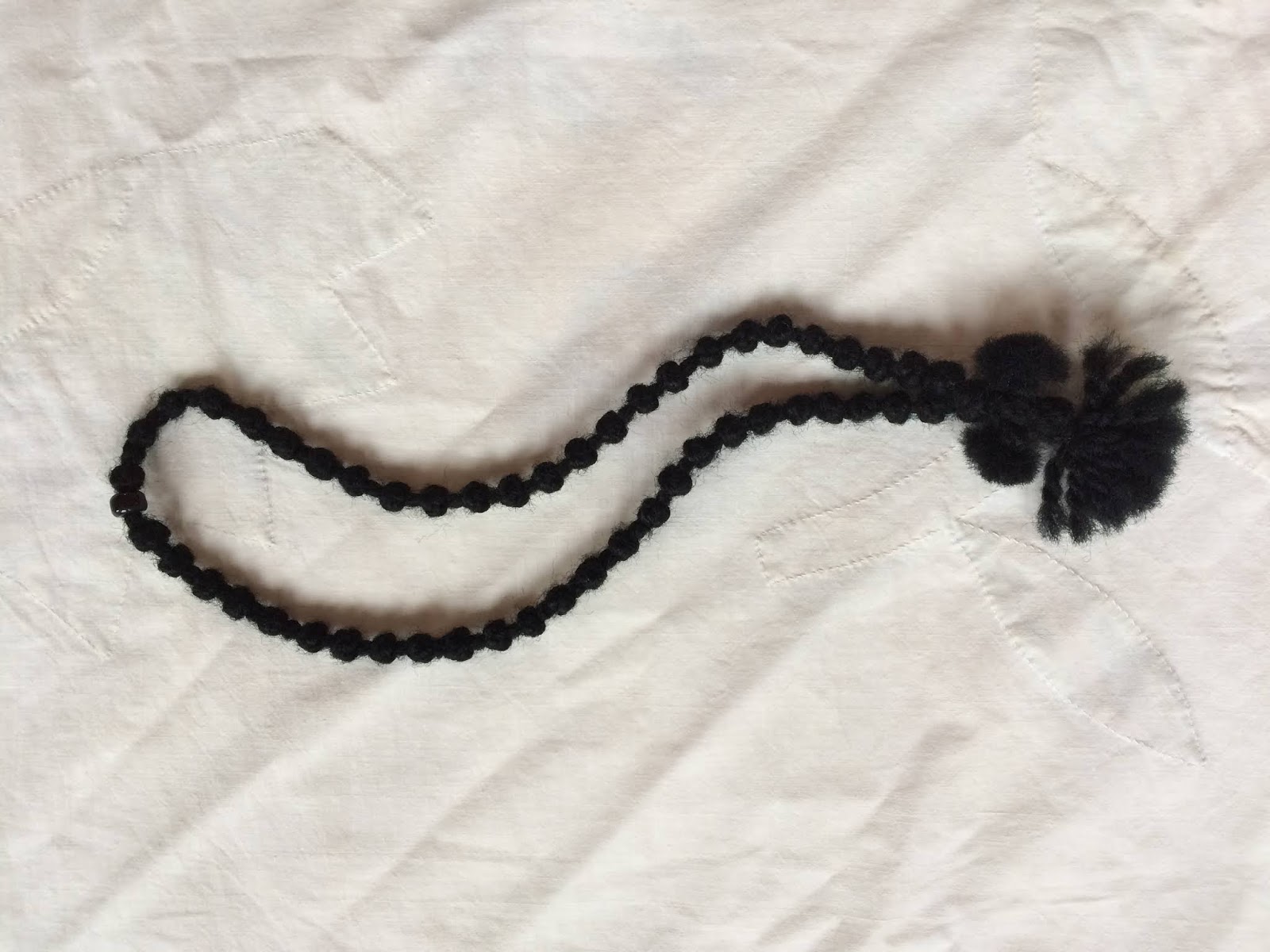
My fifty-knot koumboskene
There were no tears, no display of emotion at all.  It struck me then that there had been none in the katholikon either.  The tone of the funeral had verged on indifference.  The dead monk was not to be mourned.  Like his brothers, he had eagerly anticipated this day his entire life and had now achieved his blessed release to the realm of eternal glory.


*  *  * 

Passing the ossuary on the way out of the cemetery, it was impossible to ignore the sun-bleached skulls resting atop piles of bones gathered in used olive oil tins.  These were the remains of earlier-deceased monks who had been exhumed and now awaited permanent lodgings in the ossuary.

Bending closely over one of the skulls, a lay brother asked "Who's this?"  A grave marker resting next to the tin clearly  identified the remains, but the lay brother evidently couldn't read it.  The monk next to him answered joshingly:  "Don't you recognize him?  It's Dimitri."

On re-entering the monastery I was much relieved to learn that it wasn't Father Andreas whom we'd just buried.  It was Brother Kalistratos, who had died almost exactly twenty-four hours earlier.


*  *  *

Finally, we were brought into the visitor's room.  As at Iviron, it was decorated with portrait photos of Greek kings, Greek Prime Minister Metaxas (dead since 1941), and various patriarchs and archbishops.  The customary Greek coffee, tsipouro, and a spoon-sweet were offered.

In the guest book I wrote:  "Today a funeral, but no tears."

Wednesday, June 19, 2019

"Are You Orthodox?" (Part 7)

Having changed their plans, the architect and his son had departed for Karyes by the time I'd had my morning coffee and settled into Iviron's crumbling gazebo to do some writing.

Bishop Van Kleef in the gazebo
From a distance Iviron's  towers, walls, tiled roofs, lead-sheathed domes, thick buttresses, and rounded arches seemed to bring Byzantium back to life.  But up close most of these features were decrepit.  Seated in the gazebo that morning I felt slightly defrauded.

The gazebo itself was a charmless concrete cube erected to one side of the cobblestone plaza outside Iviron's main entrance.  I suspected it was built -- all too hastily and cheaply -- to welcome dignitaries to Iviron during Mount Athos's millenium celebration in 1963.  It clearly hadn't been re-painted since.  Standard elements of Byzantine architecture were incorporateda square plan, round arches, a circular drum supporting a shallow dome.  But the combination, a kind of Bauhaus Byzantine, was hideous.

Iviron's main entrance
Greater care and expense had been devoted to the monastery's main entrance a few paces away, but it too was a failure.  The entrance was set within a neo-classical portico of square Ionic columns, a white marble anachronism awkwardly grafted onto the monastery's medieval facade in 1867.  Back then, criticism of such a discordant renovation would probably have been out of the question.  But now I considered it fair game.

Beyond these two particular disappointments, Iviron was generally sad and tumbledown.  With few exceptions, masonry badly needed repointing.  Most wooden elements, lacking paint for years, had weathered to a rheumy gray.  Iviron was simply too big for twenty-five aging monks to keep in good repair.


*  *  *

I shifted my attention to the sea.  Two hundred yards away it lapped placidly at the arsanas bulkhead.  This boded well for accomplishing the day's objective:  hitching a ride southward on the afternoon caïque to the peninsula's tip and the monastery of the Great Lavra (Megisti Lavra).

Megisti Lavra
A lavra is an ancient type of monastery.  On Mount Athos the term applies to the three largest monasteries (Great Lavra, Vatopedi, Iviron) and to Karyes.  The Great Lavra, established in 963, is the Holy Mountain's oldest foundation.  It ranks first among the twenty ruling monasteries and is considered the mother house of the peninsula.

Cover of the Great Lavra's
"Phokas Lectionary" (10th cent.)
(from a Greek postage stamp
commemorating the Holy
Mountain's millenium)
It also holds the Holy Mountain's richest collection of Byzantine icons.  Beyond these, the Great Lavra's library contains over 2,000 manuscripts (800 are Byzantine), and its treasury is filled with precious sacerdotal vestments, liturgical implements, and holy relics.

I could have walked there from Iviron, but it would have taken eight hours two hours to the monastery of Karakallou ("Of  Caracalla") and six more to the Great Lavra.  Physically I could have done it.  I'd have to carry sufficient food and water to keep me going, of course, but that wasn't the problem.  The problem was actually getting there in eight hours before the gates were locked for the night.  I had a map, but I couldn't be certain how accurately it marked the paths.  Signage on the Holy Mountain ranged from poor to none.  I'd be completely alone much of the way (if not for all of it), so I couldn't count on local guidance.  One wrong turn and I'd be sleeping rough overnight.  And I didn't have enough days left on my diamonitirion to break the journey into two stages with an overnight at Karakallou.  It would have to be the caïque or nothing.


*  *  *

But even the caïque option was fading.  By lunchtime, oily clouds driven by a freshening breeze were sliding over the mountain behind Iviron.  They portended rough seas, in which case the caïque wouldn't sail.

But the moment of truth was still several hours away, so after lunch (onion soup with lima beans) I decided on a walk.  Turning left from the main entrance I followed a stone-paved footpath that ascended gently uphill.  It first passed alongside a wooded valley, then through a small olive grove and past an immaculate kathisma with its own chapel, the occupant nowhere to be seen.  In many places, the path was bordered by a low stone wall.  Farther on I came to the remains of a fountain, then crossed a small ravine by means of a charming stone bridge.  Beyond, the path continued through dense green forest.  Here, despite the mid-day heat, all was shady and cool.  At my feet, fluffy moss grew between the paving stones.

The Garden of the Virgin
This delightful path, truly worthy of "the Garden of the Virgin," seemed to go on forever.  For about forty minutes I had its quietude and beauty completely to myself.


*  *  *

On turning back, I encountered a bearded fellow visitor, a Greek university student studying physicsAs one does when meeting a stranger on the Holy Mountain, we fell into conversation that occupied us the entire distance back to the monastery.

Greek curiosity about the stranger is a quality well known since antiquity, and this fellow fully lived up to his heritage.  He seemed to know practically nothing of America and was particularly intrigued to meet a native.  His probing began with benign generalities about the U.S. but quickly penetrated to the personal:  "Do you believe in Christ?"  "Are you Orthodox?"  Had it not been for where we were, such questions coming from a total stranger within a few minutes of first meeting would have been terribly rudeBut on the Holy Mountain, discussions of spirituality and religion were not at all unusual, and I answered affirmatively.

He then asked about my occupation, and here my answer baffled him:  "How can you believe in Christ and also be a lawyer?"  Trying not to laugh I assured him there were many Christian lawyers in the United States.  But that didn't square with his idea of Christianity.  "They must be Catholics," he huffed.


*  *  *

Grateful to part company with him on reaching Iviron, my attention was caught by a liturgy just wrapping up in the Portaïtissa chapel near the main entrance.  Its conclusion gave me another chance to examine the icon's painted surfaces.  They were hard to make out, however.  Not only were they dark, but they were also recessed some two to three inches beneath layers of embossed gold leaf, which were themselves behind glass.  On the Virgin's throat, I could vaguely discern a mark the size and shape of a keyhole where Barbaros supposedly delivered his life-changing blow.  The monks take this mark to be a scab.  To me it looked like a knot in the wood.

Much less ambiguous were the two strands of votive coins strung across the lower part of the icon, one consisting entirely of gold pieces, the other of silver with several U.S. dollars among them.  At the bottom of the case, a heap of watches evidenced still more devotions.


*  *  *

After gathering my things I walked down to the landing.  The bus from Karyes came and went, but no 4:00 caïque to the Great Lavra.  I'd have to spend yet another night at Iviron.

Walking back up to the entrance I fell into conversation with two students who'd arrived on the bus.  Koichi was studying tax law at Kyoto University.  Albrecht was on the verge of obtaining a Master's degree in biochemistry from Tübingen University.  He'd been attending a conference on photosynthesis in Kassandra and had left his girlfriend behind in Ouranoupolis so he could spend a few days on Mount Athos.

After dinner (the same tomato-rice soup as the day before), Brother Kosmas showed the three of us to a room for the night.  As we were settling in, he introduced a young Greek priest traveling with two longtime friends, Manolis and Takis.  The three of them had met Koichi and Albrecht on the boat from Ouranoupolis and now wanted to say hello.  I didn't get the priest's name, but he could have been my cousin Nick Christopher's twin brother, both in appearance and irreverent humor.

Someone produced a bottle of ouzo, and for the next couple of hours the conversation caromed around from off-color stories to incidents of travel in Greece to philosophical musings.  At one point Koichi asked the priest why Christianity has Catholic, Protestant, and Orthodox denominations when there is a single Bible.  "Different people read the Bible differently" was the priest's œcumenical answer.

At the time, my feelings about the Greek clergy were shaped by a bigoted bishop whose preaching I'd recently encountered at New York's Holy Trinity Cathedral.  "There is only one baptism," he thundered.  "Orthodox baptism!  And don't let the Catholics or the Protestants tell you otherwise."

After that travesty, it was refreshing to hear this open-minded young priest.  I pressed him some more:  "If there's only one God, why are there so many different faiths?"  His answer gave me hope for the decency of a younger priesthood:  "Because different people believe differently."