Saturday, November 3, 2018

"Are You Orthodox?" (Part 5)

Brother Kosmas was grateful for the 100 drachmas I put into his hands "for the monastery" as I departed Iviron for the walk to Stavronikita.

The Panaghia Portaïtissa
Before leaving, however, I couldn't resist peeking into the chapel of the celebrated "Panaghia Portaïtissa."  The icon of "Our Lady of the Gate" has few peers in all of Eastern Orthodoxy.  Like many such highly esteemed images, the Portaïtissa is nearly invisible for the incrustations of gold leaf, jewels, and ex votos that shroud all but the painted faces of the Holy Mother and Child.

Supposedly painted by St. Luke himself, the icon is said to have been insulted in the home of a pious widow of Nicaea by messengers of the emperor Theophilos the Iconoclast (829-842), who threatened to denounce her for concealing an icon in her home.  One messenger pointed his sword at the Virgin's face but retreated when blood spurted onto him.  Fearing for the icon's safety, the widow furtively took it to the seashore and hurled it into the waves saying "You who can save us from an emperor's wrath can save yourself from the dangers of the sea."  Standing on edge in responsive salute, the icon headed west.

Seventy years later a pillar of fire reaching to the heavens and a voice asking by name for the hermit monk Gabriel the Georgian announced the icon's arrival offshore of Iviron.  In a cave somewhere between the monasteries of Xeropotamou and Roussikon, Gabriel was found and brought to the shore.  Given a boat, he rowed out to the icon.  Overcome with joy at getting close, he leapt out and walked the last distance over the water with arms outstretched to retrieve the icon.

It was Easter Tuesday when Gabriel brought it ashore and the monks, with great ceremony, installed it in Iviron's katholikon.  The next day, however, they discovered the icon lodged over the monastery's old entrance gate.  The monks returned it to the church, but again it was found over the gate.  After three instances of this auto-mobilism, the Virgin herself appeared to Gabriel and instructed him to build a special chapel for the icon next to the gate, "For I come to guard, not to be guarded."  It was in the chapel's late 17th century incarnation that I glimpsed the Portaïtissa that morning on my way to Stavronikita.

The Portaïtissa's stirring legend, however, has a glaring chronological flaw.  Iviron's founder (the warrior monk Thornic) didn't receive his imperial call to military duty until 979, and he didn't found Iviron until about 980.  So the Portaïtissa couldn't possibly have been received in Iviron's katholikon around Easter 912 (i.e., seventy years after the death of emperor Theophilos in 842), as the legend says, because Iviron's katholikon wouldn't be built for at least another sixty-eight years.

An image breaker, possibly the
Patriarch John VII Grammatikos (r. 837-843)
(detail from the 9th century Khludov Psalter)
But what legends worthy of the name have ever dissolved in the cold water of historical fact?  Certainly not the Holy Mountain's many legends of icons miraculously surviving the age of iconoclasm ("image breaking").  During the 8th and 9th centuries, the holiness of icons was denied and the veneration of images was officially  (sometimes brutally) banned by the Byzantine emperors and their clerical minions, setting iconoclasts ("image breakers") against iconophiles ("image lovers").  Theophilos, whose disrespect set the Portaïtissa on her 70-year voyage to Iviron, proved to be  the last iconoclastic emperor, iconoclasm being finally defeated in 843, a year after the close of his reign.  The victory is still celebrated each year with solemn processions of icons on the first Sunday of Great Lent, styled the "Sunday of Orthodoxy" in the Eastern Church.

Among monks, who by nature are prone to believe in miracles, the memory of iconoclasm's persecutions would naturally have inspired legends like that of the Portaïtissa.  Monks would recall the emperor Theophilos with particular revulsion for his decree of 836, which called for insulting iambic verses to be tattooed (some say branded) onto the foreheads of the brothers Theophilos and Theophanes, both iconophile monks (later sainted), whose epithet thereafter became graptoi ("marked by writing").

For the monks of Mount Athos, these were earthshaking events.  However inexactly, the Portaïtissa keeps their memory fresh.

She is still revered as a miracle-worker.  Centuries ago, I was told, she saved Iviron from Saracen invaders bent on razing the katholikon to the ground.  In 1404, a sword strike to the Virgin's neck by the pirate Barbaros (the mark is still seen) brought forth a torrent of blood that whelmed him to Christianity and (eventually) sainthood.  The Portaïtissa is so powerful that even a copy, devoutly painted at Iviron to the accompaniment of all-night vigils and then carried to Moscow, cured the gravely ill Alexius Michailovitch, the second Romanov tsar (r. 1645-1676).  In gratitude, he bestowed on Iviron the revenues of Moscow's St. Nicholas monastery, which provided a handsome income until the Russian Revolution.

*  *  *

The gate at Xenophontos monastery
Stepping through an Athonite monastery's gate can be slightly intimidating.  Beyond it, ancient cobblestone paths may lead through embowered forests or alongside dancing brooks; or a newly cut dirt track may mundanely connect point A to point B.  But whatever your route may be, the territory between monastic establishments will be essentially empty.  Gates separate the known from the unknown, safety from danger, monastic order from natural chaos.

A monastery's gate is typically the sole piercing in an otherwise impregnable circuit wall.  Stoutly  timbered and reinforced with iron, it is secured with cross bars and antique padlocks.  At sundown, the gatekeeper swings the great doors closed, locks them, and delivers the key to the abbot.  The doors will be opened for no one until sunrise.  Heaven help you if you linger outside too long or fail to arrive by sundown.  Leaving Iviron's secure little world behind, carrying everything I possessed in a cloth bag, left no doubt about how it must have felt to commence a journey in the Middle Ages.

*  *  *

It was mid-morning on a sunny September Sunday.  The dirt road to Stavronikita sloped gradually upward most of the way.  Heavy growth on both sides blocked any kind of view, a ruined kathisma here and there being the only break in the monotony.  For twenty minutes I encountered no one.

Then a tall solitary monk approached from the opposite direction balancing a wicker basket on one shoulder.  Mutual greetings led to conversation.  Brother Nestor looked to be in his mid-forties.  We quickly discovered our common Ionian Islands origins, he being from Zakynthos, the island immediately south of Cephalonia, my father's ancestral homeland.  Soon we were seated roadside sharing an early lunch of succulent sun-warmed tomatoes from his basket and a hunk of crusty bread retrieved from somewhere in his gown.

Brother Nestor was a hermit monk, affiliated with no particular monastery.  He was a builder and had been working in Karyes but was now returning to his kathisma near the skete of St. Anne, close to the monastery of St. Paul.

Our interchange lasted a full forty-five minutes, but it was mostly a monologue.  He needed to tell me of his past life and recommend how I should live mine.  As Charalambos (his worldly name) he'd been a merchant seaman and in the mid-1950s had spent considerable time in the U.S.  Everywhere he went, be it Brooklyn, Chicago, or Minneapolis, a local Greek wanted to "give" him a daughter to be his bride.  But married life and the temptations of the world were not for him.  He much preferred the peace and solitude of a monk's life, so he came to Mount Athos.  Temptation, he said, was the hardest evil to avoid.  "It's easy to refrain from killing or robbing, but not so easy to avoid going with women."  Much of his discourse of evil revolved around sex and relationships with women.

Brother Nestor had an answer for everything.  On learning that I was a lawyer, he told me how to plead cases in court:  "Say as little as possible, and the justice or injustice of your position will show itself.  If you're a good Christian, you'll win because God protects his own."  Christians have a great gift, he said.  "Only we can reach paradise and live with the angels."  He lamented "those poor Muslims and other heathens" who didn't have a chance.  They had souls, of course, but no hope for salvation.

On parting, he urged me to be a good Christian, to do good, maybe even become a monk.  More specifically, on Tuesdays, Wednesdays, and Fridays I should not eat oil, fruit, or cheese.  In fact I should eat moderate amounts of everything and very little meat "because that's the only way to keep your body in control" (again, the allusion to sex).  I had no need to worry about my health because, if I was a good Christian, God wouldn't let me get sick.

Thursday, December 29, 2016

"Are you Orthodox?" (Part 4)

Sir Steven Runciman
(1903-2000)
Fortunately, the night's interruptions did not include the bedbugs that harassed Steven Runciman, the Scotttish byzantinist, who passed through Iviron in 1937.

Breakfast in the trapezaria, the monastery's refectory, consisted of coffee.  Just coffee.  "Refectory," however, was much too grand a word for this strictly utilitarian room that seemed rarely used.

The reason was that Iviron was one of nine idiorrhythmic houses, where the monks took most meals in the privacy of their individual cells and shared meals communally only on the great feast days.  Idiorrhythmy was introduced in late Byzantine times to attract wealthy aristocrats to the Holy Mountain in an era of uncertainty and lax administration.  It subverted the communal standard, known as cenobiticism, by allowing monks to keep and acquire private property, profit personally from its fruits, and bequeath it to other monks.  Governance was also shifted from a single abbot (who in a cenobitic house was elected for life and exercised dictatorial authority) to a revolving committee of senior monks.

Idiorrhythmic life could be rather grand, even if still piousNaturally, worldly abuses crept in.  Secular menus (with exceptional quantities of meat) were cooked and served by private servants and consumed in spacious apartments done up to suit personal tastes and individual means.

Iviron's refectory (2016)
When I passed through in 1980, Iviron still clung to a shabby relic of  idiorrhythmy, enough to curtail communal use of its unadorned refectory to the great feast days.  But a decade later, the need for new recruits, who would not stand for the perceived decadence of idiorrhythmy, obliged Iviron to return to traditional cenobiticismJudging by the transformation of the refectory, the change has been for the better.
 
*  *  *

I was joined at one of the trapezaria's long empty tables by a weary sixty-something, a visitor like me.  Conversation soon came around to the false religiosity of Greeks.  Specifically, he had in mind his wife of thirty years, who had “turned bad” and only pretended to be a Christian.  Her great sin, he said, was refusing to help him in his time of need.

In his hometown of Volos, he and his wife had raised a son my age.  He had also raised and educated (in Belgium no less) the orphan child of one of his wife’s siblings.  He owned a used car business and three units in a large apartment building.  As was commonly done in those days, cash-strapped builders had granted him the units in exchange for title to the land on which the apartment building was erected.

His used car business had failed.  Now he owed various individuals in Volos 300,000 drachmas.  Sale of any one of the three apartments would be more than enough to pay his debts.  But the land that yielded the apartments had originally been part of his wife’s proika, her dowry, and she wouldn’t consent to sell any of them because she insisted on their son receiving a three-apartment inheritance.  He couldn’t even sell his car because it was registered in the wife’s name.  He was terribly embittered and accused his wife of being an actor when it came to religion.  Like most Greeks, he said, she went through the motions well enough, but was in it only for herself.

After leaving home and family he’d briefly driven a school bus in Athens, but the badly polluted air bothered him.  He had retreated to Mount Athos to clear his lungs and “look for an idea.”  He also came for safetyOn Mount Athos, both he and his 25,000-drachmas-a-month pension were immune from creditors.

* * *

Sulphation

Incrustation
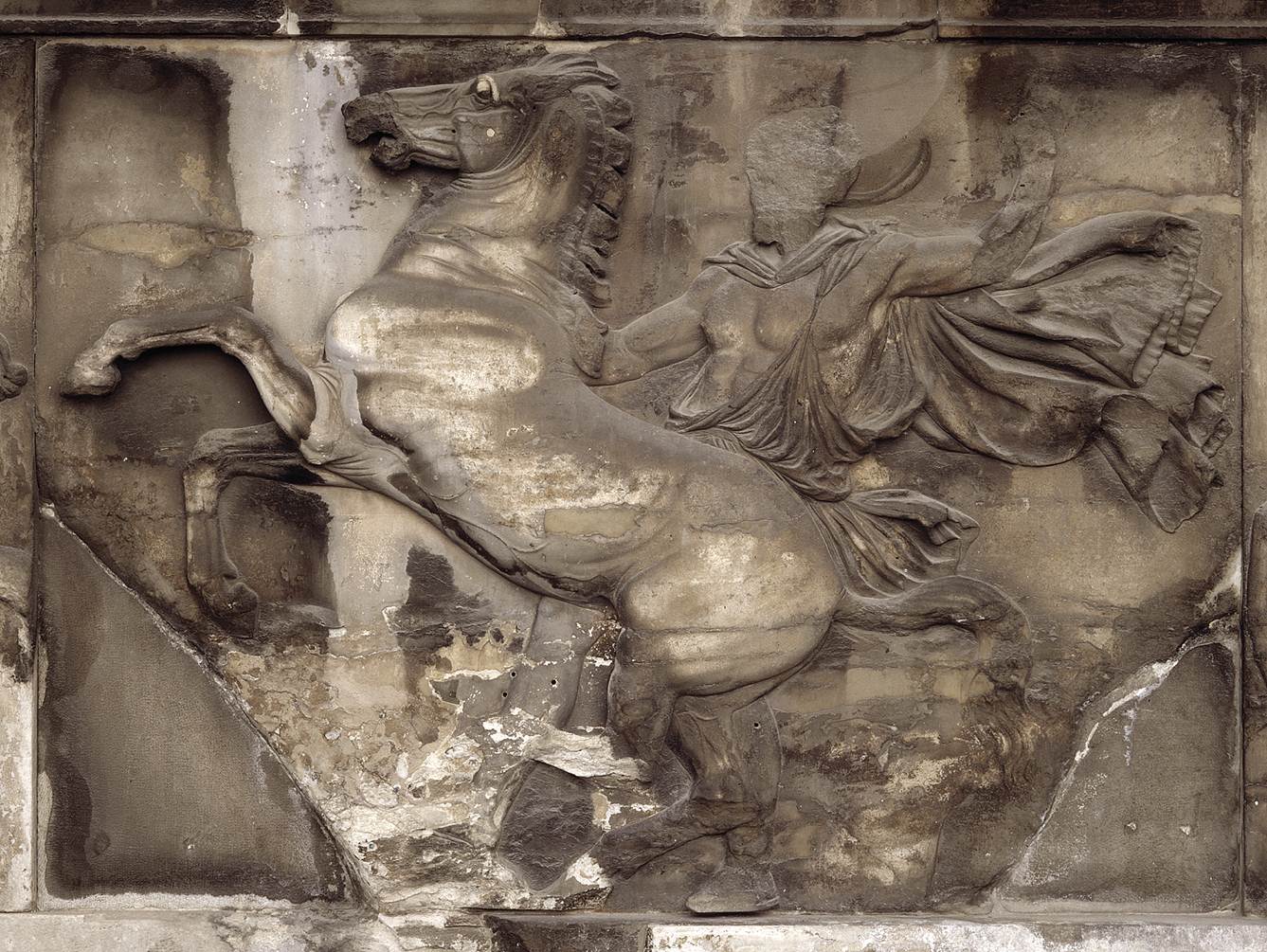
I could easily sympathize with his pollution-related complaint.  In those years, any time spent in Athens meant burning eyes and a scratchy throat.  The air was so noxious it was eating away the Acropolis, both its marvelous Periclean sculptures and the structure itself.  Sulfur oxides from car fumes and oil heating had consumed more marble since 1960, it was said, than the combined wear and tear of all the preceding centuries.  Since then, strict anti-pollution measures have been wisely imposed, and the air quality has greatly improved.

*  *  *

A dormitory wing at Iviron

The many cups of Greek coffee I downed while listening to my breakfast companion's tale of woe had worked their magic, and I could no longer avoid using the bathroom.  Brother Kosmas had guided us to it the evening before.  It was down an immensely long hallway lined on both sides with empty cells.  Through open doors I glimpsed spare kitchens and wooden built-ins serving as closets and bookshelves.  There were also stoves for winter use.

The lavatory assigned to us was in a long narrow room lit with a single window at the far end.  Below the window, a shallow depression in a whitewashed square of cement flooring announced the room's purpose.  A steady gale blew upward through a five-inch hole that pierced the bottom of the depression.  Peering down against this breeze revealed a patch of ground about four stories below.  On either side of the hole, cement footpads protruded slightly above floor level to indicate the proper stance for operations.  Balancing on one footpad while leaning slightly to the side brought a can of lye within reach, but brother Kosmas had given no instructions for its use, and no one had dared to ask.  Closer to hand was toilette tissue.  But instead of a roll, a few 4-inch-square pieces of newspaper hung from a nail.  Fewer pieces, in fact, than the number of people in our party, promising for a perverse form of musical chairs during our stay.

Sunday, September 20, 2015

"Are you Orthodox?" (Part 3)

I returned to Mount Athos in 1980, partly to see Father Andreas once more.   Getting to him was no easy task.

The "White Tower,"
Thessaloniki's landmark
As my father and I had done four years earlier, I started in Thessaloniki.  This time, however, I took the precaution of obtaining the necessary papers, which were issued by the Ministry for Northern Greece.  In the appropriate office, a cheerless woman, a Greek bureaucrat of the finest stripe, was ready for battle.

To Mount Athos the following day?  "Impossible," she declared.  "You must delay your trip for six days."

This could not be done.  “I’ll be gone from northern Greece in six days,” I informed her, slightly stretching the truth.

From prior experience, I knew to remain polite but stand firm.  I also knew that the rules of engagement with the Greek bureaucracy did not require strict adherence to the truth on either side.

I pressed on.  “I’ve come to see my aging cousin, the former hegoumenos of St. Paul’s.”  It was the truth, but not the whole truth.  Seeing Father Andreas, a first cousin once removed whom I'd met only once before, wasn’t my sole purpose for being in northern Greece.

Still impossible, came the response.  Five more minutes of tactful thrust and parry finally produced an opening through which I could see victory and she could make an honorable retreat.

“Are you Orthodox?” she inquired 

On my affirmative answer she disappeared into an inner office.  About fifteen minutes later she emerged with three official-looking papers, each in its own envelope.  One was for deposit in a nearby gendarmerie.  The other two were for presentation at Karyes, the administrative capital of the Holy Mountain.

Very early next morning I was on the bus to Ouranoupolis seated next to Prodromos, an affable young monk returning to Stravronikita, his monastery.

*  *  *

At Ouranoupolis I boarded the regular boat for Dafni, again a wooden caïque but larger than Ammouliani four years before.  It was crowded with goods and men, many of them monks returning to their monasteries from sojourns “in the world.”

Among the passengers was a tall white-haired man.  From behind I could hear him speaking knowledgeably about Mount Athos in accented English.  Perhaps a Byzantine scholar on holiday, I thought.  On turning around, his open jacket revealed a purple shirt and clerical collar.  He was Bishop van Kleef of the Old Catholic Church of Haarlem, which, despite its name, is an 18th-century split-off from Roman Catholicism now in union with the Church of England.  

While deeply interested in exploring Mount Athos, he criticized its monks for devoting their lives not to the salvation of mankind but to the salvation of themselves, which he deemed a “selfish form of Christianity.”  Even so, he was generous enough to allow (in a left-handed sort of way) that the monks could not be judged with Western logic and had to be accepted in the context of Orthodoxy.

On my other side was a crabbed Greek man, unshaven and wearing a battered fedora.  I didn’t pay him much attention but noticed that every so often, while conversing with one of the monks, he kissed a small crucifix drawn from a pocket.

Now he interrupted my conversation with Bishop van Kleef to ask, "Are you Orthodox?"  My response elicited his apparent need to out-Orthodox me.  "This is my seventh pilgrimage to Mount Athos," he preened.

Then he noticed a book of short stories in my bag.  Its cover, decorated with an image of sensuous red silk, drew his gimlet-eyed inquiry:  “Does it contain erotika?”  I assured him it did not, abandoning the truth altogether. 

What he really wanted was to know about the purple-shirted fellow I had been speaking with in English.   “What business does he have here?” he grumbled, pouncing on the “Catholic” part of my explanation.  He was no kinder in judgment of his own church’s hierarchy, denouncing the Greek Orthodox archbishop in the United States as a no-good and a Mason.

Starting with Docheiariou, one of the imposing monasteries that slides by on the seaward route from Ouranoupolis to Dafni, he began distracting me with his map of the peninsula, tediously pointing to the label for each monastery as if the map required decipherment.  His annoying assault continued intermittently for the remainder of the hour and a half trip to Dafni.

Landing at Dafni
As we disembarked, he unctuously proposed that we explore Mount Athos together.  I declined.

*  *  *
From Dafni, we lurched up the dirt road to Karyes in an ancient bus, the only vehicle I saw on the peninsula.  The road, the first ever built on the Holy Mountain, was opened in 1963 so that Œcumenical Patriarch Athenagoras I, King Paul of the Hellenes, his son Crown Prince Constantine, and the other dignitaries who attended the millenial celebrations that year would not have to walk or ride mules the twelve kilometers to Karyes as their imperial and patriarchal predecessors had done for centuries.  As I was to learn, more such roads had later been built to facilitate the movement of service and emergency vehicles.  Despised by traditionalists, the roads now formed a handy network connecting the major houses.

As it was, the old bus's speed never much exceeded a walking pace, so it took fully forty-five minutes to reach Karyes.  The winding route skirted the monastery of Xeropotamou ("Dry Torrent"), one of Mount Athos's richest in its 10th century heyday, but now much diminished.

The Protaton
Karyes, the capital of this theocratic republic, proved to be no more than a tumbledown two-street village.  The bus deposited us near the 10th century Protaton ("The First"), the oldest church on Mount Athos and unusual among Orthodox churches for its basilican plan.

With obligatory stops at the local gendarmerie and then the office of the Holy Epistasia, we presented our papers and were each issued a diamonitirion, the local visa, but only after paying the entrance fee.  In Greek, a cassocked cashier asked “Are you Orthodox?”  My affirmative reply required me to pay 100 drachmas.  Without asking, I was granted a three-day extension of my visit.

My 7-day diamonitirion, signed by the
four Epistatai and dated August 31 (Julian-style)

Behind me, Bishop van Kleef was next in line.  With strained English and an exaggerated smile, the cashier asked him “Aahr ghiou Orthodox?”  The bishop answered truthfully.

“Five hundred drachmas, please,” came the smiling reply, but no extension.

*  *  *
A latter-day view of Iviron,
with its arsanas in the foreground
From Karyes, travelers went their separate ways.  Mine involved another twenty-minute judder in the bus, which labored eastward to Iviron, the monastery of the Iberians.

Set on a broad shingle about two hundred yards from the sea, Iviron was founded in the late 10th century not by the Spanish Iberians but by the Georgian ones.   Particularly instrumental was the warrior-monk John Tornikios, better known as Thornic.  In 979-80, at the call of emperor Basil II (nicknamed Voulgaroktonos, the “Bulgar-Slayer”), Thornic led an army of 12,000 Georgians against the rebel Bardas Skleros, throwing him back into Persia.  With his share of the resulting booty, Thornic established one of the Holy Mountain’s largest and oldest monasteries.

Iviron's katholikon
(the phiale is out of view)
On arrival we were ushered immediately into the katholikon, the main church, sacred to the Dormition of the Virgin.  Conforming with tradition for the decoration and layout of Athonite ruling monasteries, the katholikon is painted the color of the Blood of Salvation and stands in the courtyard by itself, graced with mournful cypresses and the phiale, a ceremonial fountain sheltered in a decorative open-sided pavilion.

Surrounding the courtyard like the curtain walls of a castle are banks of balconied cells.  The brethren are called to prayer by a monk who circles the katholikon three times while balancing the six-foot semandron horizontally at the shoulder.   This stout board he hammers in a rhythmic tattoo echoing the sound of Noah's tools.  His first circuit calls forth the reptiles and crawling creatures, the second is for the four-footed animals, and the third summons the Sons of Man to the symbolic Ark of Salvation.

Facing the altar
A liturgy was underway and we remained for its last twenty minutes.  The late-afternoon light was diffused in clouds of incense, but I could make out boldly colored frescoes on every available surface.  They were arranged in the typical pattern of Athonite churches:  warrior saints in the lowest range, evangelists and fathers of the Church in a band above, scenes from the life of Christ higher still, ranks of Old Testament prophets and kings in the top level, and finally Christ Pantokratoros ("All-Sovereign") glaring down from the lofty central dome.  Underfoot was a beautiful floor of opus Alexandrinum and suspended overhead an immense corona chandelier, at least thirty feet across, elaborately worked in brass and enamel.  On Mount Athos, these coronas are swayed into motion during Christmas liturgies to symbolize the joyous dance of the angels and the saved around the heavenly throne.

Afterward we were led up flights of creaking stairs to a sunny reception room where we signed the guest book and were welcomed with ouzo and spoon sweets dispensed by brother Kosmas, the guest-master.  The room had a magnificent view of the sea but was a complete, though harmless, misfire at worldliness.   Old-fashioned gilt furnishings, mostly threadbare, bespoke a naive and mannish idea of elegance.

More poignant were the ranks of heavy picture frames hung too high on the walls.  They bore sepia-toned portraits of men and women in court dress and orders of chivalry, the mostly defunct royal families of Europe, the Balkans, and Russia.  In the reception room, time had come to a distinct halt around the turn of the century, an aberration in the otherwise timeless aura of the Holy Mountain.

The Kantakouzenos
chrysobull
The coronation of John I Tzimiskes
After our welcome we were invited to tour the library.  Dinner at 6:30 was fast approaching, however, so our tour in slanting late-afternoon sunlight was curtailed to a hasty ten minutes.

Even that, however, was sufficient time to give a hint of the legendary treasures of Mount Athos.  One dusty glazed case displayed a chrysobull bearing the scarlet autograph signature of John VI Kantakouzenos (d. 1383), the historian-emperor.  Another contained a richly embroidered sakkos (dalmatic), part of the regalia worn by emperor John I Tzimiskes at his coronation in December 969 a few days after murdering Nikiphoros Phokas, his predecessor in title.

Following dinner (macaroni swimming in watery olive oil accompanied by bread, olives, and kefalotiri cheese), six of us and a squadron of houseflies were assigned to a spacious corner bedroom for the night.  Our sleep was interrupted three times either by the banging of the semandron or the clanging of church bells announcing nighttime offices at 2 AM and 4 AM and matins at 6 AM.

The next morning I rose at eight o’clock feeling as though the day were already half finished.  Nighttime prayer is more efficacious, we were told.


The image of the coronation of John I Tzimiskes is from a 12th or 13th century manuscript of the Synopsis Historiarum by John Skylitzes (fl. 1081) in the National Library of Spain [http://www.wdl.org/en/item/10625/view/1/327/].

Saturday, September 5, 2015

"Are you Orthodox?" (Part 2)

I'd had a glimpse of Mount Athos four years earlier.

On a July morning in 1976, my father and I left Thessaloniki in a rented car and headed east in the hope of meeting his first cousin, Angelos Evangelatos, a monk of Mount Athos.

The trip was organized on a whim, and we had allowed only one day for it.  Our haste left no time to obtain necessary travel permits, so we began the day’s adventure not knowing whether we would be allowed past Ouranoupolis, the last town in Greek territory and the starting point for the boat services that run up and down the peninsula’s western coast.  Our plan was to talk our way onto a boat that would take us from Ouranoupolis to a meeting place somewhere on the western shore where we had been told Angelos was living.

Ouranoupolis with the Prosphori Tower (13th cent.)
The three-hour drive through mountains to Ouranoupolis yielded a cloudless warm day and a calm sea.  We had missed the last regular boat down the coast, however, so we had to scrounge for private passage.  The necessary bargain was struck at the Café Athos, which served as a clearinghouse for local service providers.  Soon we were gliding down the coast in Ammouliani, a motorized wooden caïque, in the company of its captain, two crew members, and Vangelis Tsirbas, the dark scrawny chain-smoker who would be our guide.

Tsirbas and Dad
In view of our lack of permits, Tsirbas said, there would be no point in stopping at Dafni, the sole clearance station on the western coast.  There would also be no going ashore at our destination.  Greek gendarmes patrol Mount Athos, and our captain, he warned, was not about to risk losing his coasting privileges by allowing permit-less travelers to set even one foot onto the beach.

Two of the Three Brothers
About six miles down the coast, we dropped Tsirbas at the Tria Adelphia (“Three Brothers”), a sea-worn protrusion of rocks marking a small landing place from which a gravel path ascended the hillside.  An hour’s climb would lead Tsirbas to a kellion near the chapel of St. Nicholas where, according to what we’d been told, he would find Angelos.

To kill the time, we continued down the coast.   Our captain and one of the two crew members mostly slept, leaving the driving to the other crew member, the captain's nephew.  The boy was no more than thirteen but seemed to know where he was going.

Arsanas of Zographou ("Of the Painter")
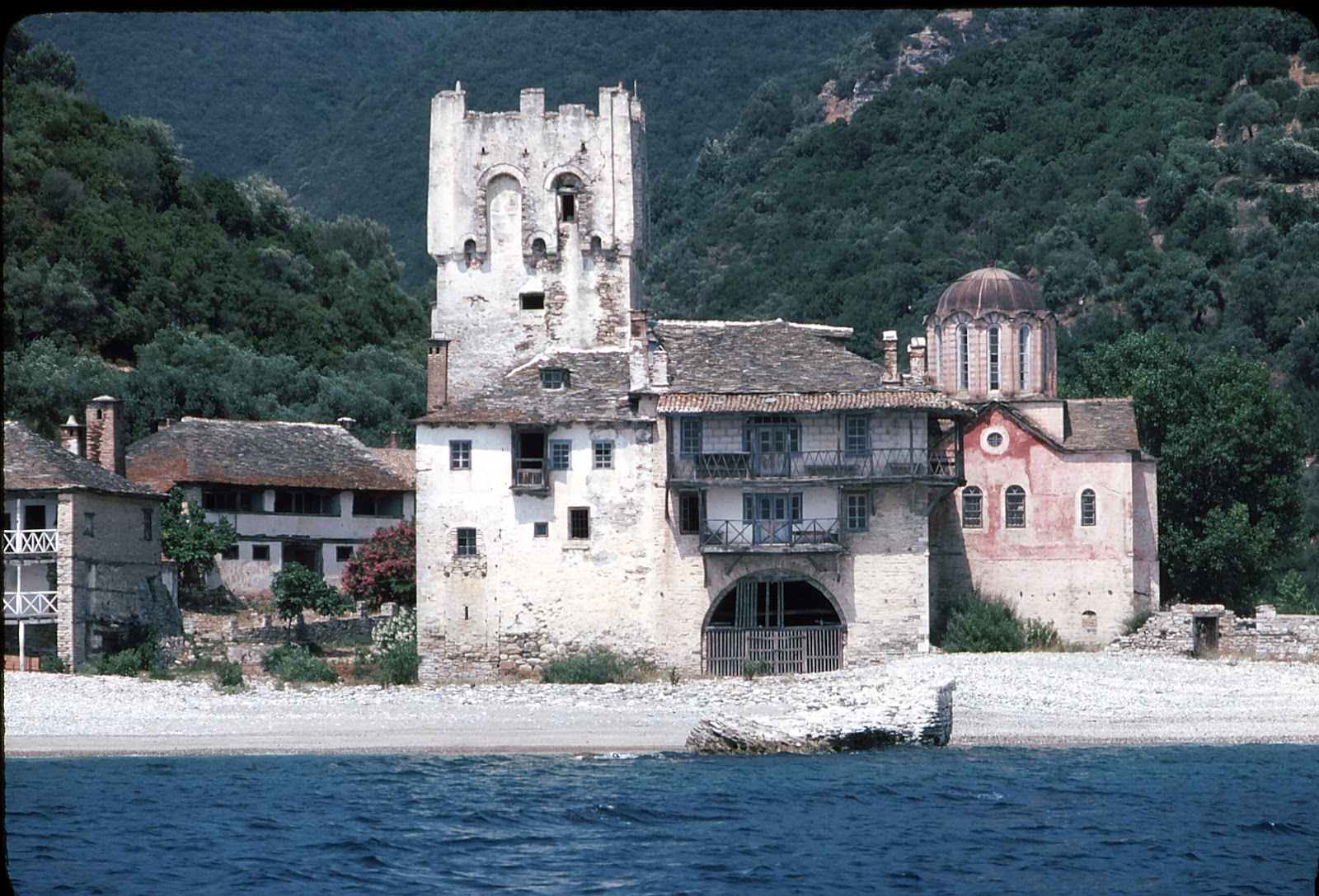
Intriguing sights made us deeply regret our double lack of time and permits.  Large multi-storied buildings dotted the shore, the arsanades (landing places) for monasteries hidden inland behind coastal hills.   The arsanades were obviously very old, but their style, an exotic hodgepodge of fortress-like masonry below and half-timber above, was unrecognizable and impossible to date.  Here and there, stout crenellated towers silently testified to an Aegean Sea once infested with Saracen and Catalan pirates.  The structures were uniformly ramshackle and lifeless, but complex stonework and traces of faded color hinted at a more robust past.

Docheiariou ("Of the Steward")
Farther down the coast, monasteries began revealing themselves high up in rocky declivities and down nearer the shore.  They, too, displayed the strange defensive architecture of the arsanades but were much larger.  Some were immense.  Magnificent towering structures slid by in a litany of names and laconic descriptions:  “Chilandariou.  The Serbian monastery.”  “Zographou.  The Bulgarian house.”  “Docheiariou.  Thirty monks.”  “Xenophontos.  Thirty-five.”  “Panteleimonos.  Russians.  We call it Roussikon.  See the big dormitories?  They used to house two thousand.  Only fifteen now.”

Roussikon
Had we gone a little farther, we would have seen St. Paul’s, cousin Angelos’s former monastery, which had thirty-five or forty monks, we were told.  But we had to turn back to the pre-arranged meeting place, a patch of empty beach within sight of Dafni.

Angelos and Tsirbas approach
Just as we arrived, Tsirbas and Angelos were dismounting the mules that had carried them down the mountainside.  Angelos steadied himself along the rocky shore with a length of bamboo.  As he and Tsirbas approached, Ammouliani's captain and crew put down an anchor at the bow to hold us off and led a line ashore to steady the stern.

Full-bearded and seventy-three, Angelos wore a simple black cassock, his long grey hair tied back under a black pillbox cap.  Even from a distance and before he said a word we recognized him from the startling resemblance to Atzouleta, his sister, whom we knew well from visits to Athens.  Hiking up his cassock to avoid the gentle surf, he climbed aboard.   Then, standing upright on the rolling deck, he embraced us teary-eyed and presented a gift of sweet grapes.

Following the usual custom on becoming a monk, he had abandoned his worldly name and became Andreas.  He did not stand on ceremony, but out of respect we addressed him as Father Andreas.  He had been, after all, hegoumenos (abbot) of St. Paul’s.

Cousins meet
Settled on top of the hold under an awning spread against the sun, we spoke with him for most of an hour.  Within minutes it was clear that he shared not only Atzouleta’s facial features, but also her easygoing manner and penchant for homegrown humor.  With an impish smile he apologized for having just eaten three cloves of garlic to hold down his blood pressure.

In 1936, with Europe on the brink of war, his family had rebuked him for abandoning them and the world.  As the eldest son, he was expected to look out for his widowed mother and younger siblings, not disappear to a life of monastic isolation.  But with the passage of years all was forgiven, and a lifetime on Mount Athos, far from worldly cares, had made Father Andreas sublimely happy.  In forty years he had left the peninsula only a handful of times, lately for medical treatment in Athens.

He hadn’t lived too badly, either.  In anticipation of coming war, the monks had laid in extra stores of grain and other staples.  While the rest of Greece starved, the monks ate well.   Their needs were not very acute in the first place, and their over-supply, he told us, had continued to feed them until quite recently.

He described a simple life lived in total peace:  no cars, no phones, no lawyers, no crime.  His typical dinner was a slice of bread, some chick peas, and olives.  He lived solely to work, pray, and enjoy the beauty of God's creation.  It was essentially the same as how Cristoforo Buondelmonti, the Florentine traveler, had found Mount Athos around 1420:

"Here, in lush valleys, teem bees, figs, and olives.  The inmates of the monasteries weave cloth, stitch shoes, and make nets.  One turns the spindle of a hand-loom through the wool; another twists a basket of twigs.  From time to time, at stated hours, all essay to praise God.  And peace reigns among them, always and for ever."

On mention of my niece, born three years earlier with an ailment that made it uncertain she would walk, he promised to light a candle and pray for her.  He was obviously touched by the trouble we had taken to find him and deeply regretted not being able to show us around.  Sadly, a more prolonged visit was impossible.

Father Andreas parted as tearfully as he had arrived.  Watching him return alone across the beach to his tethered mule was to witness a scene that has repeated itself on Mount Athos for a thousand years.

 The Buondelmonti quotation serves as the epigraph to Robert Byron's The Station (Alfred A. Knopf, New York:  1928), an account based on his visits to Mount Athos in 1926 and 1927.

Friday, September 4, 2015

"Are you Orthodox?" (Part 1)

Many Septembers ago, I had a month to kill between the end of a judicial clerkship and the start of my first law firm job.  What else to do but spend the month in Greece?

Nowadays, memories of that long-ago trip keep flooding back.  Perhaps they're a reflexive antidote to the awful daily news from Greece -- the shattered economy, the austere hopeless future, the overwhelming flood of Middle Eastern refugees.

Zeus, in the form of a bull,
hooking up with Europa

Things were very different in 1980.  Greece was vibrant and full of hope.  European Union membership was less than a year away and seemed to be on everyone’s mind.  At last, Greece was going to take its place as a proper European nation.  The very name “Europe,” Greeks were quick to tell you, derived from cow-eyed Europa, the Theban princess whom Zeus abducted to Crete for amorous amusement.

But behind the bravado, Greeks were unsure of their Western bona fides, which had been compromised by a Byzantine millenium, four centuries of Ottoman paralysis, and a century and a half of spotty Westernization after independence in the early 19th century.  In 1980, Greeks boarding flights to London or trains to Paris still spoke of “going to Europe.”

That September, with Greece on the verge of redeeming its Western identity, I chose to spend a few days exploring Mount Athos, an ureconstructed throwback to Byzantium.  "It was too rewarding a holiday to go unchronicled," as John Julius Norwich, the popular historian of Byzantium, so aptly said of his own 1964 visit to Mount Athos.  I therefore offer this multi-part record of my experience.

But first, some necessary background.


*  *  *

Mount Athos is actually a thirty-mile peninsula that points like an arthritic finger southeast into the Aegean Sea from northern Greece.  Starting from a low plain in the northwest, the peninsula rises gradually southeastward, bursting at its terminus into a majestic 6,000 foot conical peak.

The mountain’s influence on place names extends well beyond the peninsula.  Eighty miles away across the Aegean Sea one of the northern Sporades islands is called Skiathos, the “shadow of Athos.”

Still visible near the mainland, where the peninsula is lowest and narrowest, is the faint transverse scar of Xerxes’ Canal, now completely filled with sediment.  Commencing in 483 B.C. at the outset of his assault on the Greeks, the Persian tyrant spent three years digging a two-kilometer ditch wide enough for two triremes to pass through abreast.  He was determined to avoid the fierce storms that often rage around the end of the peninsula, one of which cost king Darius, his father, three hundred ships and twenty thousand men while attempting the same mission a decade earlier.  Using the canal, Xerxes safely transited the peninsula.  But like his father he met defeat farther south, for which the names Thermopylæ, Salamis, and Platæa echo down the ages.

A few centuries later, the architect Dinocrates proposed to sculpt the entire tip of the peninsula into an immense statue of his king, Alexander the Great.  The king's left hand would hold a city of ten thousand inhabitants; from his right hand a mighty river would flow into the Aegean Sea.  Fortunately for the age of monasticism, Alexander demurred.

 
*  *  *
Because Mount Athos is home to the most important center of Eastern Orthodox monasticism, Greeks call it Aghion Oros, the “Holy Mountain.”  Its borders are entirely within the territory of Greece, but the Holy Mountain is completely independent.  For more than a thousand years its right of self-governance has been protected in turn by Byzantine emperors, Ottoman sultans, Balkan princes, Russian tsars, and now by Article 105 of the Greek constitution, which ordains that Mount Athos shall, “in accordance with its ancient privileged status, be a self-governed part of the Greek State, whose sovereignty thereon shall remain intact.”

To enter Mount Athos in 1980 was to return to the Middle Ages.  There was no electricity, hence no telephones, radio, or television.  The silence was punctuated only by natural sounds; and at night the complete absence of ambient light made the stars particularly brilliant.  What little running water was available had to be pumped from wells or collected at springs, but it was refreshingly cold and delicious.  Save for one old bus and the caïques that ran up and down each coast, there was no motorized transport.  But the necessity of walking or riding a mule from place to place gave you time to notice an unusual flower here or the detail of an arch there.

As in the Middle Ages, the wider world receded completely away.  Local concerns were all, and life became intensely Christ-centered.

Simonopetra (13th cent.), one of the
Holy Monasteries of Mount Athos
Monks lived humble and simple lives in a variety of residences.  The monasteries themselves, built in times of great faith, were grand and capacious.  But for upkeep they depended on large and vigorous populations and on the regular benefactions of emperors and kings.  The demise of imperial Russia and the collapse of the Balkan kingdoms had taken the expected toll on recruits as well as resources.  So in 1980, even though the monasteries still had income from metochia (ancient holdings beyond the peninsula), they were, with few exceptions, unkempt, dilapidated, and thinly peopled with aging monks.  Some of the larger ones were in ruinous state.

Monks also lived outside the monasteries, some in one of twelve sketæ, village-like communities, some quite large, dependent on an associated church.  Others lived in kellia, small farms, often with their own chapel.  Kalyvæ were similiar to kellia but smaller, and the monks were occupied with handicrafts rather than farming.  In a kathisma, usually one monk lived alone dependent on a nearby monastery.  Finally there were the hesychasteria, isolated hermitages in desolate spots, some in caves, others clinging at dizzying heights to steep cliffsides, approachable only by tortuous paths and steps.

A hesychasterion at Karoulia, the "Place of the Pulleys"
 *  *  *

Mount Athos is perhaps best known for its ban on women.  In fact the ban extends to all female creatures, though obvious exceptions are made for wild animals, birds, and insects.   For practical reasons, certain monasteries also allow female bees, she-cats, and even hens.   The ban also extends to eunuchs and the "beardless," meaning young boys, though the latter ban is widely ignored and the former is of limited utility these days.

The ban on women comports with traditional Eastern Orthodox practice, which bars women from monastic establishments.  Rightly or wrongly, it is believed that minds will refrain from dangerous thoughts if eyes cannot wander to shapely distractions.

Over the centuries, the ban has acquired mythical proportions.  In one version, the Virgin Mary, sailing from Joppa to visit her friend Lazaros on Cyprus, was blown off course to Mount Athos.  When she came ashore, the peninsula's pagan idols recognized her immediately and, admitting their falsity, shook themselves to bits.  Before leaving, Mary pronounced the peninsula her private garden and forbade it to other women.

Whatever the ban's origins, it has been strictly enforced through the centuries.  Since 1953, Greek law makes entry of any "female creature" onto the territory of the Holy Mountain a crime punishable by imprisonment.  Where this leaves the likes of Caitlyn Jenner is anybody's guess.


*  *  *
Mary, as Theotokos ("God-Bearer"),
crowning emperor John I Tzimiskes
Monastic life on Mount Athos is based on rules laid down in a series of typika, imperial charters.  The first and most important of these is the so-called Tragos (literally, "billy goat"), a nearly ten foot long roll of goatskin parchment.  Granted in 971 or 972, it bears the autograph signature of emperor John I Tzimiskes ("John in Christ our God faithful emperor of the Romans") and is kept in a strongbox in the archives at Karyes, the Holy Mountain's administrative capital.  It was last removed during World War II.

Legally speaking, Mount Athos is a theocratic federation governed by twenty "ruling" monasteries, each of which sends an elected representative to reside in Karyes for a year.  Together they form the Holy Synod, which has supreme administrative authority.  Day-to-day executive power is exercised by the Holy Epistasia, a committee of four selected from the Holy Synod.   Each of the four Epistatai holds one quarter of the Holy Synod's official seal, which validates the committee's documents only when all four pieces are united.

The Holy Mountain’s continuous independence since official foundation in 963 A.D. makes it the world’s oldest surviving republic by far.  Spiritual jurisdiction lies with the Greek Orthodox Œcumenical Patriarchate in Istanbul.  And just as Mount Athos has outlasted most political regimes, it has also outlasted Istanbul’s former name, Constantinople.

I turn again to Viscount Norwich:

"For the fact is that Athos is something infinitely greater than the sum of its monasteries.  It is not a community so much as a concept; and the grandeur of this concept, however misguided it may ultimately prove to be, can have a profound -- at times almost a shattering --  effect on those who wander within its range.  They find themselves by turns entranced and revolted, bewildered and enlightened, depressed and exhilarated, terrified and consoled.  . . . As they learn more of the Mountain, so they also grow to understand more of themselves; and they emerge beset with a maelstrom of conflicting emotions and impressions that can only be resolved on paper."

Quotations are from J. Norwich & R. Sitwell, Mount Athos (Harper & Row, New York:  1966) at p. 14.